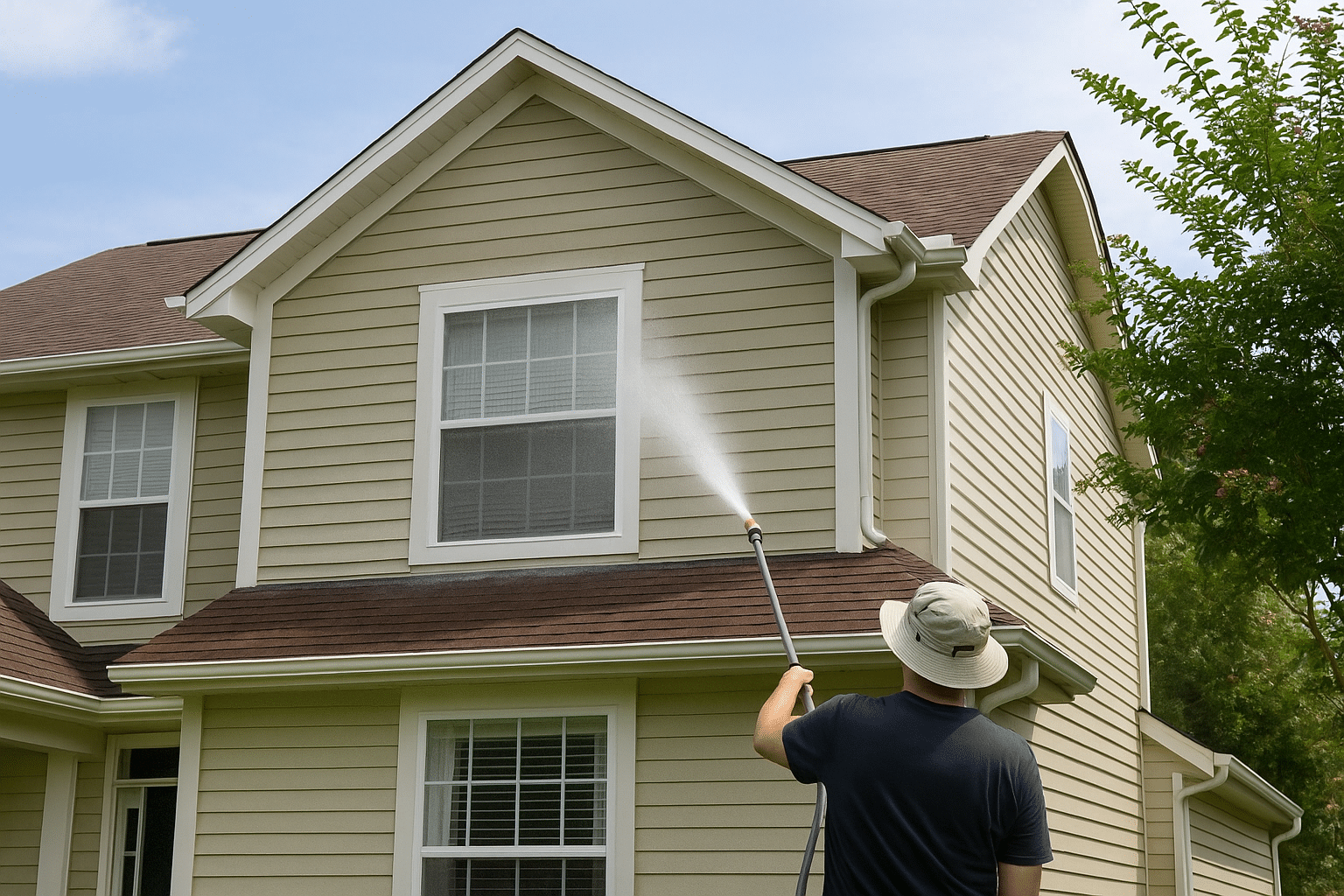
There's a cleaning contractor in every Scottish town who'll arrive at your house with a petrol-powered pressure washer, blast your slate roof at 3,000 PSI, and charge you £350 for the privilege of permanently damaging it. The roof will look cleaner — for about 18 months. Then the moss will return (the pressure washer didn't kill the spores, just brushed off the visible growth), the slate surface will be visibly pitted, and the manufacturer warranty on any tiles replaced in the last 20 years will be void. This article explains why soft-wash is the correct protocol for Scottish roofs, what the chemistry does, and how to spot a contractor who's about to wreck your roof.
We clean 600+ Scottish roofs a year — Victorian tenements in Glasgow, granite villas in Aberdeen, slate-roofed cottages in the Borders, modern concrete-tile estates in Livingston. Every one of them gets soft-washed. Never pressure-washed. Here's the science behind that decision.
What pressure washing actually does to a roof
Slate and concrete tiles have a surface layer — the weathering surface — that's structurally distinct from the body of the tile. On slate, this is the riven face: the natural cleavage plane that gives slate its characteristic texture and its water-shedding capability. On concrete tiles, it's the pigment-and-cement slurry applied at the factory, which both colours the tile and provides the weathering seal.
Pressure washing at 2,000+ PSI strips this surface layer. On slate, you'll see the riven face become smoother and paler — the natural cleavage plane is being eroded, exposing the more porous underlying slate. On concrete tiles, you'll see the colour fade as the pigmented slurry is blasted away, exposing the grey concrete body. The tile now sheds water less efficiently, absorbs more rainwater, and is significantly more vulnerable to frost damage.
The warranty issue
Every major tile manufacturer (Marley, Redland, Russell, Sandtoft) explicitly excludes pressure washing from their warranty coverage. The warranty small print typically says: 'Cleaning by high-pressure water jetting shall render this warranty null and void.' If you pressure-wash a 12-year-old roof with a 30-year warranty and a tile fails at year 15, the manufacturer will inspect, see the pressure-washing damage, and refuse the claim. You're paying for the replacement.
Why moss returns after pressure washing
The visible moss on your roof is the fruiting body of an organism whose root structure (rhizoids) penetrates the tile surface. Pressure washing removes the visible moss but leaves the rhizoids intact — and the roughened, pitted surface left behind by the pressure washing is a better substrate for moss re-growth than the original tile. The moss will return, typically within 18-24 months, and it'll be more deeply established than before.
Soft-wash chemistry kills the entire organism — root and fruiting body. The biocide (typically a quaternary ammonium compound or a sodium hypochlorite solution at controlled dilution) is applied at low pressure (40-80 PSI, similar to a garden hose), allowed to dwell, and then rinsed gently. The moss dies, the rhizoids decompose, and the tile surface is left intact.
The soft-wash protocol
Here's the protocol we use on every Scottish roof. It's the same protocol regardless of tile type (slate, concrete, clay) — only the dwell time and chemistry dilution vary.
- ✓Pre-inspection: drone or ladder survey to identify damaged tiles, loose flashings, and the moss/algae species present. Different organisms need different chemistry.
- ✓Mechanical removal: loose moss physically removed with a soft-bristle brush (no metal, no scraping). All debris caught in tarps and disposed of — never allowed to wash into the gutters.
- ✓Chemical application: biocide sprayed at 40-80 PSI (garden hose pressure, not jet). The chemistry is applied to saturation — until it just begins to run off.
- ✓Dwell time: 30-60 minutes depending on organism and tile type. The chemistry works by contact — rushing the dwell time means incomplete kill.
- ✓Gentle rinse: low-pressure rinse (60-100 PSI) to remove dead organic matter and chemistry residue. No high pressure at any point.
- ✓Post-treatment biocide: a lighter second application of biocide, left on the tile as a residual kill layer. This continues to work for 6-12 months after the clean.
- ✓Gutter clear: all gutters and downpipes checked, cleared, and flushed. Soft-washing dislodges organic matter that ends up in the gutters.
Side-by-side: pressure wash vs soft-wash
| Factor | Pressure wash | Soft-wash |
|---|---|---|
| Application pressure | 2,000-4,000 PSI | 40-100 PSI |
| Effect on tile surface | Strips weathering layer | No surface damage |
| Moss kill | Surface only (rhizoids survive) | Full kill (root + fruiting body) |
| Moss return | 18-24 months | 3-5 years |
| Manufacturer warranty | Voided | Unaffected |
| Water usage | 500-1,000 litres per roof | 100-200 litres per roof |
| Runoff contamination | High (chlorinated, high volume) | Low (controlled, dilute) |
| Cost | £250-£400 | £350-£500 |
| Lasting result | Short-term cosmetic | Long-term remediation |
The cost myth
Pressure washing is cheaper on the day (£250-£400 vs £350-£500 for soft-wash). But the moss returns in 18 months — you'll need to clean again, £250-£400. And the tile surface is damaged, shortening the roof life by 5-10 years. Over a 10-year horizon, soft-wash costs £350-£500 once; pressure washing costs £1,500-£2,400 in repeated cleans and contributes to a roof replacement that should have been 10 years further out. Soft-wash is cheaper. Significantly cheaper.
Why soft-wash lasts longer in the Scottish climate
Scotland's climate — wet, mild, with prolonged high humidity — is the ideal growth environment for roof moss, algae and lichen. The organisms grow faster here than anywhere else in the UK. Which makes the residual biocide layer in soft-wash particularly valuable — it continues to suppress re-growth for 6-12 months after the clean, breaking the growth cycle.
Pressure washing, in contrast, leaves the roof in a damaged, roughened state that's more receptive to moss spore germination than the original tile. In Scotland, that means moss returns faster after pressure washing than after soft-washing — typically 18 months vs 3-5 years. The very climate that creates the moss problem also makes pressure washing the worst possible response to it.
If a contractor turns up with a petrol pressure washer to clean your roof, send them away. The roof will look cleaner for the photographs, but you've shortened its life and the moss will be back within two years. Soft-wash costs a little more on the day, lasts four times as long, and protects the warranty. There is no scenario in which pressure washing a Scottish roof is the right answer.
— Ross Paterson, Head of Green Chemistry
If your roof has visible moss growth, get a soft-wash quote. The cost is £350-£500 for a typical 3-bed semi-detached, the result lasts 3-5 years, and the warranty stays intact. Call us, call another soft-wash specialist — but don't call the pressure-washing contractor. Your roof will thank you.