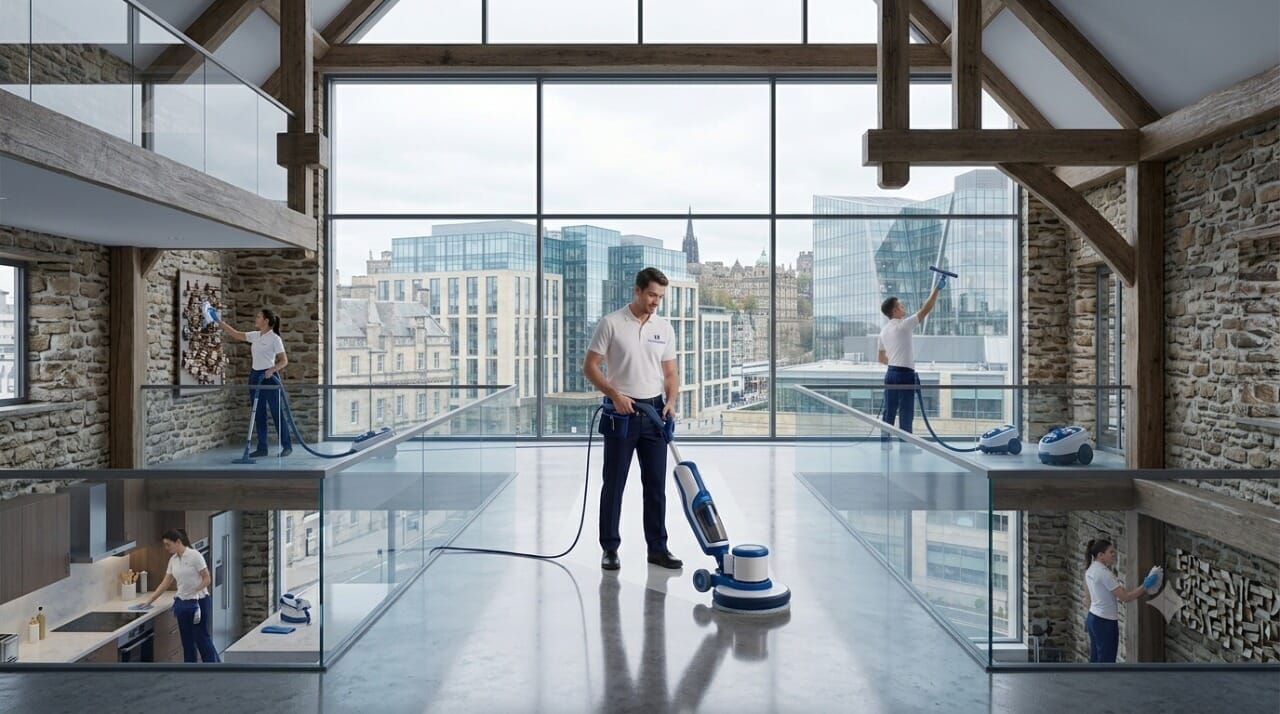
Every commercial cleaning contract has the same shape: a comfortable January-September where the agreed scope fits comfortably within the agreed hours, and a brutal October-December where footfall doubles, opening hours extend, and the agreed scope can't keep up. Most contractors respond by adding hours reactively — at premium rates, with whichever operatives are available, often with quality dropping. By January, the client has overspent, the contractor has underdelivered, and both sides are eyeing the contract renewal date.
We manage 80+ commercial cleaning contracts across Scotland — retail chains, hospitality venues, corporate offices, university estates. Over 12 years we've developed a 'busy season framework' that scales cleaning coverage without burning the annual budget. The framework is the same across sectors; only the calendar shifts. Here it is.
Step 1: Identify the busy season calendar
The first step is mapping the actual busy season — not the assumed one. Most clients say 'Christmas' when they actually mean 'mid-November to first week of January'. The specific dates vary by sector:
| Sector | Busy season | Peak week |
|---|---|---|
| Retail (high street) | 10 Nov — 5 Jan | 15-22 Dec |
| Retail (shopping centre) | 1 Nov — 5 Jan | 8-22 Dec |
| Hospitality (restaurant) | 1 Dec — 2 Jan | 22-23 Dec + 31 Dec |
| Hospitality (hotel) | 15 Dec — 3 Jan | 27-31 Dec |
| Hospitality (pub/bar) | 15 Dec — 2 Jan | 22-23 Dec + 31 Dec |
| Corporate office | 20 Dec — 5 Jan (low season — use for deep cleans) | n/a |
| University estate | Mid-April + mid-Dec (exam weeks) | Variable |
The point of this exercise is to identify the exact weeks where coverage needs to scale. A 6-week busy season needs a different resourcing plan to a 10-week one. And the quiet weeks before and after the busy season are when you do the deep cleans that prevent the busy season from being worse than it needs to be.
Step 2: Calculate the footfall uplift
How much busier is the busy season? Most clients say 'a lot' — which is unhelpful for planning. We ask for the actual footfall numbers, then calculate the uplift. The pattern is remarkably consistent across sectors:
- ✓Retail (high street): footfall up 40-60% during busy season, peak weeks 80-120% above baseline
- ✓Retail (shopping centre): footfall up 50-70%, peak weeks 100-150% above baseline
- ✓Hospitality (restaurant): covers up 60-90%, peak nights (22-23 Dec, 31 Dec) 150-200% above baseline
- ✓Hospitality (hotel): occupancy up 30-50% (less dramatic but with higher room turnover)
- ✓University estate: footfall up 20-30% during exam weeks, then drops to near-zero over holidays
Footfall uplift is the basis for resourcing. A 50% footfall increase doesn't mean a 50% cleaning hour increase — high-traffic touchpoints need 50% more attention, but back-of-house areas may not need any. We split the cleaning scope into 'traffic-driven' (touchpoints, restrooms, entrance areas, floors) and 'schedule-driven' (offices, meeting rooms, storage areas) and uplift only the traffic-driven scope.
Step 3: Identify the scope split
Every commercial cleaning scope has two components: the traffic-driven scope (which scales with footfall) and the schedule-driven scope (which is constant). The split varies by sector but typically looks like this:
| Sector | Traffic-driven scope | Schedule-driven scope |
|---|---|---|
| Retail | 60-70% (entrance, floors, restrooms, touchpoints) | 30-40% (back office, stockroom, staff areas) |
| Hospitality (FOH) | 70-80% (dining area, restrooms, bar, entrance) | 20-30% (BOH, kitchen, offices) |
| Corporate office | 30-40% (reception, meeting rooms, restrooms) | 60-70% (desks, offices, break rooms) |
| University estate | 40-50% (lecture theatres, library, restrooms) | 50-60% (offices, labs, corridors) |
The traffic-driven scope is what you uplift during the busy season. The schedule-driven scope stays at baseline. This is the single most important insight in the framework: you don't double the cleaning hours during the busy season — you double the cleaning hours on the 60-80% of the scope that's traffic-driven, while keeping the schedule-driven scope at baseline. A 100% footfall uplift translates to a 30-50% increase in cleaning hours, not a 100% increase.
The budget math
If your annual cleaning budget is £100,000 and you don't plan for the busy season, you'll either overspend (£115-130k actuals) or under-clean (visible dirt, EHO risk, customer complaints). With the framework: baseline budget £90k (90% of annual hours, Jan-Sep), busy-season uplift £10k (10% of annual hours, Oct-Dec). Total £100k. The budget balances. The cleaning delivers. No surprises.
Step 4: Schedule the pre-season deep cleans
Two weeks before the busy season starts, do a full deep clean of the entire premises. This is the single most cost-effective intervention in the framework. Why? Because the busy season is when your cleaning crew is stretched thinnest — they don't have time for deep-cleaning tasks. If the premises starts the busy season in a deep-cleaned state, the crew can maintain that state with traffic-driven cleaning only. If the premises starts the busy season in a baseline state, the crew will be playing catch-up from week one.
- ✓Carpet extraction throughout (deep-lift soil that weekly vacuuming won't reach)
- ✓Floor strip-and-refinish (VCT, linoleum) — refreshes the protective layer before the high-traffic months
- ✓Kitchen deep clean (hospitality) — gets the BOH to EHO-Excellent before the season starts
- ✓Restroom deep clean — descale, re-seal, re-silicone, replace any degraded grout
- ✓HVAC clean (if applicable) — air quality matters more in winter when windows stay closed
- ✓Window clean (interior + exterior) — daylight matters in Scottish winters
Step 5: Add the peak-week surge
Within the busy season, there's a peak week (typically 22-31 December for retail and hospitality). This is when you need surge coverage — additional operatives, additional hours, additional visits. The surge is short (1-2 weeks) but intense (often 100-150% of busy-season hours).
We handle surge by holding a reserve crew — 15-20 trained operatives who work a regular schedule January-November and are deployed onto surge contracts during December. The reserve crew is cross-trained in multiple sectors (retail, hospitality, office) so they can be deployed flexibly. Clients pay a surge premium (typically 25% on standard rates) for the peak week, but the cost is contained because it's a 1-2 week surge, not a 10-week uplift.
Step 6: Schedule the post-season reset
The first week of January is for the post-season reset. Another full deep clean — but this time to remediate the wear-and-tear of the busy season rather than to prepare for it. Carpet extraction to lift the additional soil. Floor refinish to repair the scuffing. Restroom deep clean to address the heavier usage. This is what gets you back to baseline, ready for the quiet months of January-March.
The pattern is the same every year: clients who plan for the busy season balance their budget and maintain their standards. Clients who don't plan overspend, under-clean, and end up with a January reset that costs 2-3x what a planned pre-season deep clean would have cost. The framework isn't complicated. It just needs to be in place by October — not December.
— Callum Bain, Operations Director
If your cleaning contractor hasn't raised the busy-season conversation by mid-October, raise it yourself. The conversation should cover: which weeks are your busy season, what's the footfall uplift, what's the scope split, when do we schedule the pre-season deep clean, what surge coverage do we need for peak week, and what's the post-season reset plan. If your contractor can't answer those six questions, find a contractor who can. The framework works — but only if it's actually used.